White-Faced Saki monkey was born at the Miami Zoo
- By : Darkredowl
- Категория: Miami news, News
- Tags: miami news, monkeys miami zoo, news, White-Faced Saki monkey
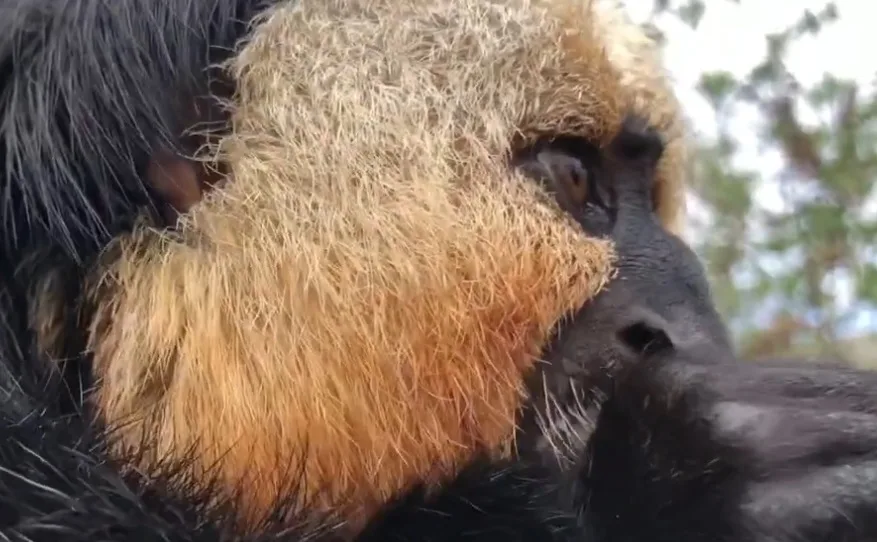
White-Faced Saki monkey was born at the Miami Zoo
Great news was announced by the Miami Zoo.
A beautiful baby was born there.
Here’s what the Miami Zoo said.
Zoo Miami is happy to announce the birth of a White-Faced Saki monkey that occurred on Wednesday, September 27th! Since the birth, mom and baby have remained isolated in a secluded holding area to ensure that they were able to properly bond without any disturbance. During the past week, the newborn has been observed nursing and appears to be in good health.
Mom and baby were recently given access to their habitat as part of a careful introduction back to a normal routine. The mother, named, „Alejandra,“ is 13 years old and was born at the Oregon Zoo. She is very protective of her infant which makes it difficult to get a clear view of it as it is cradled on her chest covered in a thick coat of hair. The sex of the baby has not yet been confirmed. The father’s name is „Macky“ and he is also 13 years old and was born at the Ellen Trout Zoo in Texas.
White-Faced Saki monkeys are arboreal and found in the tropical forests of Venezuela, Guyana, French Guiana, Brazil and Suriname. They are known for their ability to jump up to 30 feet between trees as they traverse the forest canopy where they feed mostly on fruits, seeds, nuts and invertebrates. Distinguished by their thick fur and bushy tails, adults grow to between 3 and 4 pounds. Adult males are generally a bit larger than the females and are distinguished by their black hair and white face as opposed to the females which are generally brown to gray in color without the white face. Their main predators are large birds of prey, jaguars, ocelots and large constrictor snakes. Their biggest threats are habitat loss and capture for the pet trade, although their population in the wild is currently considered to be stable.
Moving forward, mother and baby will be out intermittently in their habitat at the Flooded Forest Building at the zoo’s Amazon and Beyond Exhibit as the infant gets comfortable with its new surroundings.
It is a species of the Microhylid family, which is a group of small monkeys living in the tropical forests of South America.
White-Faced Saki monkey is also called Guianan saki or Golden-faced saki and has the Latin name Pithecia pithecia.
This species is found in Brazil, French Guiana, Guyana, Suriname and Venezuela.
It lives in the understory and lower canopy of the forest, feeding mainly on fruits, nuts, seeds and insects.
It is adapted for life in trees, with strong hind legs that enable it to make long jumps.
To sleep, he curls up like a cat in the branches. He is a very timid and cautious animal.
The White-Faced Saki monkey shows remarkable sexual dimorphism in its coloration and size.
Females have shorter fur than males, with a brownish-gray coat and white or pale brown bands around the corners of the nose and mouth. Males, on the other hand, have a darker coat, with a reddish-white forehead, face and throat. Their faces are much whiter than the females and the males are larger in body. Males weigh about 500 grams more than females.
White-Faced Saki monkeys breed throughout the year and give birth to one pup after about 150-180 days of gestation. The young are weaned after 4 months and reach full maturity after 3 years. Their life is up to 30 years.