Watch Chandrayaan-3 landing on the moon right now
- By : Darkredowl
- Категория: News
- Tags: Chandrayaan-3, Chandrayaan-3 live, india moon landing, moon, moon landing, vikram, vikram live
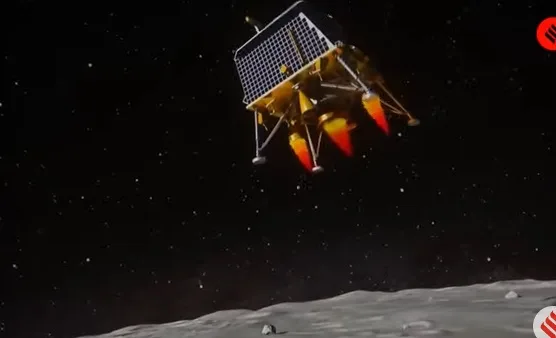
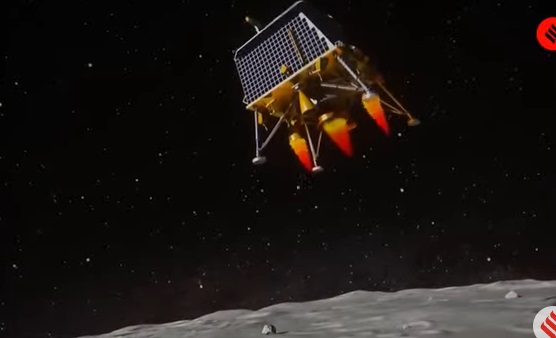
Watch Chandrayaan-3 landing on the moon right now
The Indian Space Research Organization (ISRO) mission may go down in history as the first to land on the Moon’s south pole. If all goes well, India could be only the third country to have a soft landing on the moon.
Update: 14:09
THE FOUR PHASES OF HORROR
The last few minutes of the moon landing were called „15 minutes of terror“ by ISRO chairman during Chandrayaan-2. These 15 minutes will remain equally crucial and nerve-wracking during the Chandrayaan-3 mission and consist of four phases:
Hard Stop Phase: During this phase, the horizontal speed of the lander must decrease from about 6,000 kilometers per hour to almost zero for a soft landing.
Hold phase: At an altitude of about 7.43 kilometers above the lunar surface, the lander will tilt from a horizontal to a vertical position while traveling a distance of 3.48 kilometers.
Fine turn phase: This will last about 175 seconds, during which time the lander will travel about 28.52 kilometers horizontally to the landing site, while decreasing altitude by about 1 kilometer. Chandrayaan-2 lost control between the hold phases and fine braking.
Final Descent: This is the final stage when the fully vertical lander must land on the surface of the Moon.
After a 40-day journey starting from the Satish Dhawan Space Center in Sriharikota, the Chandrayaan-3 mission of the Indian Space Research Organization (ISRO) is now gearing up for landing.
If all goes well, the Vikram lander should make a soft landing on the Moon at 18:04 IST (15:34 Bulgarian time) on August 23.
You can watch a live stream of the landing below. It will start at 14:57 Bulgarian time.
Before the launch, ISRO said it was ready to start the automatic landing sequence of the mission. The space agency plans to do so at 14:44 IST. From this point on, the Vikram lander will use its on-board computers to attempt a soft landing on the moon.
The Chandrayaan-3 mission is a follow-up to the 2019 Chandrayaan-2 mission, when the Vikram lander crashed into the lunar surface. The main goal of the mission is simple – to demonstrate the space agency’s ability to perform a soft landing on the Moon.
The launch of the Chandrayaan-3 mission. Credit: ISRO
If the mission succeeds, India will join a small and exclusive club of countries that have managed to soft land on the moon. So far, the club has three members – the United States, the Soviet Union and China. Russia made its first attempt to land on the moon since 1976 (when it was part of the Soviet Union) with the Luna-25 mission.
Luna-25, as the Russian space agency announced on Sunday, crashed into the lunar surface.
Interestingly, Luna-25 was intended to be the first mission to land on the Moon’s south pole—the goal of both Chandrayaan-2 and Chandrayaan-3. Now only India has a chance in the race.
Update: 14:09
THE SHOW IN REAL TIME
The last few minutes of Chandrayaan-3’s landing, or the ’15 minutes of terror’, will be crucial in deciding whether the mission is successful or not. But during those 15 minutes, the Vikram lander will be controlled by the program built into its computers, instead of remotely piloted. Of course, mission controllers at ISTRAC will be watching it closely, but the entire operation will be handled in real time by the spacecraft’s systems.
That’s because it takes about two seconds to send or receive a radio signal from the moon.
This could mean a delay of as much as four seconds in responding to an emergency scenario, which would be too much. That being said, the best method would be for the spacecraft’s autonomous systems to handle the situation.
“If all the sensors fail, if everything fails, it will still land, provided the propulsion system is working well.
That’s how it’s designed. Even if two of the engines fail, this time the lander will be able to land. It is designed in such a way that it can handle multiple failures. If the algorithms work well, we should be able to do a vertical landing,“ ISRO chairman Somanath said earlier this month, referring to the mission’s landing systems.
Why ISRO wants to explore the lunar south pole
Only three countries have managed to make a soft landing on the moon so far – the United States, the former Soviet Union and China – and all of their spacecraft have landed near the moon’s equator. There’s a reason for that. The polar regions of the Moon are relatively inhospitable and lack terrain and climate conducive to long-duration space missions.
So why does ISRO want to land near the south pole?
Many previous orbital missions, including the Chandrayaan-1 mission in 2008, have hinted that the relatively unexplored polar regions of the Moon present interesting possibilities. There is a chance that evidence of frozen water ice will be found there.
Also, since these regions are extremely cold, anything caught there would be frozen in place, turning the areas into something of a „time capsule.“ Studying the Moon’s polar regions can help scientists better understand the early life of the Solar System, including the formation of our planet and the Moon.