Ridley Scott sets Europe on fire: Napoleon is like Hitler and Stalin
- By : Darkredowl
- Категория: News
- Tags: napoleon, napoleon dictator, napoleon movie, napoleon stalin hitler, ridley scott, was napoleon like hitler
Ridley Scott sets Europe on fire: Napoleon is like Hitler and Stalin
Ridley Scott’s film „Napoleon“ ignited passions in Europe that had not been seen in decades.
Scott himself compared Napoleon to Hitler and Stalin, which angered France.
Is he right?
Napoleon was undoubtedly a dictator, a charismatic personality, an undisputed military genius, blindly followed by millions of people.
He rose to the top on mountains of corpses, precisely of those who blindly follow him.
Unlike Hitler and Stalin, however, he is a liberal dictator.
He freed almost all of continental Europe from centuries-old feudalism, which had stopped its development for centuries.
It does not carry out purges among the population, neither on a religious nor on an ethnic basis.
In many places they accept him as a liberator and follow him willingly.
The Napoleonic wars dealt a blow to the feudal system of the continent, above all in two of the important countries at that time – Austria and Prussia. Although the French troops brought freedom to the peoples, Napoleon himself soon became a „despot“ in the eyes of these peoples, which gave rise to powerful national liberation movements on the continent (mostly in Germany and Spain), which later led to the redrawing of the map of Europe and the formation of new states.
The French press described the film as pro-British and anti-French.
Scott replied that „the French do not like themselves“
However, the truth is much more prosaic.
Scott achieved another market triumph, and the nationalistic passions, driven from the mothballs of Europe’s bloody history, pour more and more millions and possibly billions into the revenue.
The film broke the ratings charts, despite absurd discrepancies with the facts such as the fiction that Napoleon watched the beheading of Marie Antoinette or that he ordered the firing of the pyramids in Egypt.
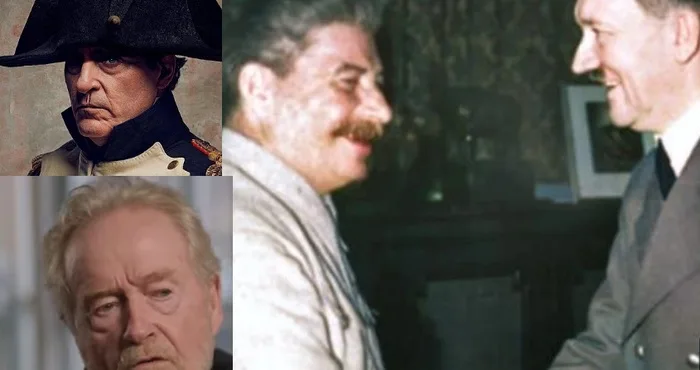
Napoleon has been compared to Hitler and Stalin and Scott himself states
„I would compare Napoleon with Alexander the Great, Adolf Hitler, Stalin,“ says Scott in an interview with Empire magazine.
„He’s got a lot of skeletons in his closet.“
When Adolf Hitler was sightseeing in the Nazi-occupied French capital on June 23, 1940, on his first and only visit to Paris, Hitler went to Napoleon’s tomb and said:
„It was the greatest and most beautiful moment of my life“
For him and his supporters, the occupation of France was a just revenge.
Rematch for what not in the historical clash between the French and German civilizations.
Would Hitler have had it at all if Napoleon hadn’t had it before?
Today, Ridley Scott, director of the long-awaited „Napoleon“, compares the French emperor precisely with Hitler and Stalin.
The film, in which Joaquin Phoenix plays the main role of Napoleon, went on the big screens about a week ago, but Scott’s comments caused dissatisfaction among the French public, writes „Slaveykov Square“.
„I would compare Napoleon with Alexander the Great, Adolf Hitler, Stalin,“ says Scott in an interview with Empire magazine. „He’s got a lot of skeletons in his closet.“
The French reaction was immediate:
„Hitler and Stalin did not build anything and bring only destruction,“ the Napolean Foundation said in a statement sent to the British Telegraph. – Napoleon built a lot, some of what he built is still in place.
Napoleon did not destroy France or Europe, his legacy was later appreciated, accepted and further developed.“
Ridley Scott tells the story of the French conqueror through his turbulent relationship with Josephine (played by Vanessa Kirby). Beginning his career as a brilliant military strategist, Napoleon took power in 1799, taking advantage of the period of political instability following the French Revolution.
During his reign, he concentrated almost all state power in the government, renovated the banking system and education.
But as one of the „skeletons in his wardrobe“ is undoubtedly perceived the series of bloody wars, started with the aim of building a giant French empire, notes the BBC.
By 1812, almost all of Europe was subject to the emperor—directly, through proxy rulers, or through treaties of cooperation—with the exception of Great Britain, Portugal, Sweden, and the Ottoman Empire.
His campaign of occupation was halted in 1815 with the Battle of Waterloo.
Napoleon conquered not only vast European territories, but also pop culture – Arthur Conan Doyle called his professor Moriarty the „Napoleon of Crime“;
Charlotte Brontë owned part of his coffin; in Orwell’s Animal Farm, the pig who becomes a dictator is called Napoleon.
But is Napoleon justly labeled a dictator?
„It is certainly debatable whether Napoleon was a tyrant,“ commented Philip Dwyer, professor of history at the University of Newcastle, Australia, quoted by the BBC. „I’m inclined to accept the tyrant point, but it certainly doesn’t compare to Hitler and Stalin, two authoritarian dictators who brutally oppressed their peoples and whose actions resulted in the deaths of millions.“
in a ‘police state’ but few opposition figures lost their lives under Napoleon, argues Prof Dwyer.
“If I had to compare Napoleon to anyone, I would go back in history to Louis XIV, the absolute monarch who started unnecessary wars at the cost of thousands of lives. Napoleon also waged wars – whether they were necessary or not – and sacrificed the lives of millions, but we do not know the number of civilians killed as a result of the hostilities.”
It is absurd to compare Napoleon with Hitler or Stalin, agrees French journalist and Telegraph columnist Anne-Elizabeth Moute:
„Napoleon did not have concentration camps.
He did not subject minorities to mass extermination like Hitler and Stalin.
Yes, the police acted for political reasons, but ordinary citizens lived as they pleased and spoke as they pleased.“
The French overwhelmingly see the emperor as a reformer, she added.
But others, such as Charles Esdale, professor of history at the University of Liverpool and author of several books about the emperor, find him warmongering.
„This is a man driven by his personal ambition, absolutely unscrupulous – comments Prof. Esdale. – A man who had a clear vision for the country he wanted to build and for Europe to support his war machine.
The ideas that he was some kind of liberator or trailblazer, that’s all part of the legend surrounding his personality.“
Propaganda was a particularly valuable tool during the French Empire and daily fed the perception that everyone wanted war with France.
„This enduring legend continues to work today,“ says Esdale. – Napoleon had many faults and deserves loathing, but he simply does not have the racial ideology that supported the Nazi regime. Napoleon did not initiate genocide and did not engage in racial cleansing. The number of political prisoners during his time in power was relatively low. To compare him with Hitler and Stalin is historical folly.“